Monday, March 19, 2007

Arizona's new law complicates struggle to designate Tempe's oldest area

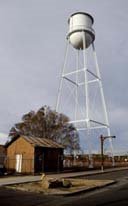
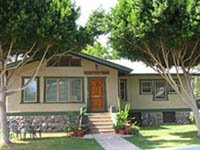
[Source: Margaret Foster, Preservation Online] -- The oldest surviving neighborhood in Tempe, Ariz., isn't an official historic district, and some neighbors have asked the city council to approve its designation before it's too late. Located between downtown Tempe and Arizona State University, the Maple-Ash neighborhood contains 240 houses, most of which were constructed between 1900 and 1940. "We have a tremendous amountt of development going on around us. We have probably eight high-rise projects within less than half a mile of us," says Jenny Lucier, a resident in favor of the designation. "Historic preservation hasn't been very popular here in Tempe."

If Maple-Ash is named a historic district, owners would have to wait six months to demolish a historic structure and also ask the city's historic-preservation commission to approve exterior changes to houses, according to the city's ordinance. Lucier and others in favor of the designation may hit a stumbling block this month, when the state's new Proposition 207 goes into effect. Modeled after Oregon's controversial property-rights law Measure 37, which critics say will encourage development, the law allows property owners to seek compensation from the state for any reduction in their right to use, divide, sell, or possess their property caused by the passage of any land-use law. Those land-use laws include historic districts. Last month, in response to "Prop 207," the League of Arizona Cities and Towns issued a report that recommends governments to require 100 percent support before designating a historic area.

[Note: To read the full article, click here. Photo source: Jenny Lucier.]

Call for nominations for the 2007 Heritage Preservation Honor Awards

The Arizona Preservation Foundation and the Arizona State Historic Preservation Office announce the call for nominations for this year's Governor's Heritage Preservation Honor Awards. This award celebrates historic preservation in Arizona by recognizing the varied contributions of volunteers, professionals, organizations and agencies to promote the goals of historic preservation. Ten honor awards are given to those projects, businesses, organizations, educational programs, or individuals who exemplify outstanding achievements in the preservation of Arizona's prehistoric and historic resources.

Selection of award recipients will be made by a panel of judges drawn from the fields of archaeology, architecture, history, and preservation. This year, presentation of the awards will take place on Thursday, June 14, 2007 at a ceremony to be held in conjunction with the Statewide Preservation Partnership Conference held at the Elks Theater in Prescott. A Grand Award Winner will be selected from the ten winners and announced at the lunch. To obtain a nomination form, as well as additional information about the upcoming Statewide Preservation Partnership Conference, visit the Arizona State Parks website or the Arizona Preservation Foundation's website. Nominations are due by April 6, 2007.

Wednesday, March 14, 2007

[Source: Heather MacIntosh, Preservation Action] -- Advocates from around the country convened on Capitol Hill last week to engage legislators in top historic preservation issues. More Preservation Action members attended than ever this year, and we’re hearing good things from the Hill and from our members. In general, we’re seeing a lot of new faces on the Hill (not just legislators, but many new, young staff members) and receptivity is up. Here’s what we’ve heard about the top Lobby Day issues:

The Historic Preservation Fund. The mood among appropriators was slightly different this year. According to the Washington state delegation, Interior Appropriations Subcommittee Chair Norm Dicks (D-WA) was more committal than he’s been over the last several years. Dicks was a leader for a conservation trust fund at the end of the Clinton Administration. He is now in the perfect position to follow through on long-requested appropriations levels. We asked for $50 million for State Historic Preservation Officers, $10 million for survey, $30 million for Save America’s Treasures and $10 million for Preserve America grants.

Thus far in this Congress, signals about the appropriations environment have been mixed. Peter Kiefaber, clerk of the Senate Interior Appropriations Committee spoke to our group of advocates on February 27 and noted that the additional appropriation request tied to the survey would likely be well received. Kiefaber noted that being able to tie HPF funds to clear investments that have paid off – and economic development in general – will make a huge difference. According to his House counterpart, the additional funding request is less of a certainty. Most delegations advocated for additional funding by providing information about specific HPF-supported projects.

The Community Restoration and Revitalization Act (improvements to the Federal Rehabilitation Tax Credit (FRTC) Program). This year advocates asked legislators to support a bill of amendments to the FRTC, and already, we’re seeing an uptick in cosponsors.

Master plans scheduled to be discussed at forum

[Source: Mike Walbert, Arizona Republic] -- The ideas for how to create a park in downtown Gilbert underneath the water tower have been flowing for the past year. Now Gilbert is gathering the public, officials and stakeholders to bottle that bubbling input into one cohesive plan. Gilbert is aiming to wrap up the design process and start utility work by the end of May, town spokesman Greg Svelund said. The whole project could be finished around late spring or summer 2008, Svelund said. According to plans, the park would sit underneath Gilbert's 120-foot-tall water tower and feature landscaping and yet-to-be-finalized amenities.

One amenity that Svelund said is "pretty much a done deal" is a water feature. Gilbert has studied several traditional and non-traditional water fountains, as well as other water features, he said. "It's going to be a fairly prominent aspect of the park," Svelund said. Officials and local stakeholders have expressed interest in other features such as a small outdoor performance area, trail connections, shade and seating. Gilbert secured a $312,000 Arizona Heritage Fund grant last year to pay for part of the park. [Note: To read the full article, click here.]

City of Chandler Request for Proposals

The City of Chandler, Arizona is seeking proposals for the development of the City-owned property known as Site 6, which is located at the northwest corner of Arizona Avenue and Chicago Street. The City’s vision for this site is an urban, mixed-use project that incorporates modern architecture and amenities into Historic Downtown Chandler. The project may include a variety of components, including commercial, cultural, entertainment, hotel, institutional, office, restaurant/retail, residential, supporting parking and other compatible uses. The City’s current policy also calls for the Chandler Historical Museum to be located on the site.

The City has seen extensive redevelopment in the Downtown in recent years and numerous projects are at various stages of development. These projects include the construction of over 130 townhomes, new court facility, new City Hall, new Chandler Historical Museum, as well as roadway, circulation and utility improvements. Chandler has experienced phenomenal population growth over the past few decades – with an eight-fold increase since 1980. An educated workforce provides the skilled labor needed by technology-based companies that make Chandler home, including Intel, Freescale, Microchip, Motorola, Orbital Sciences, and Avnet.

The City of Chandler invites firms to review the complete Request for Proposals package at its website and to consider submitting a response. To view the RFP Document, click here. To view the Related Exhibits and Appendices, click here. Proposals for the development of this site must be submitted on or before 5:00 p.m. MST, May 4, 2007. If you have any questions, please contact Richard K. Mulligan by phone(480-782-3032) or e-mail (richard.mulligan@chandleraz.gov).

Oro Valley says no to more money for Honey Bee

[Source: Daily Star] -- The town of Oro Valley will not contribute money toward an additional $680,000 needed to pay for archeological work on a Hohokam village located within the town, the Oro Valley Town Council recently said. Pima County — not Oro Valley — must find other sources for additional money, the council decided in a public meeting last month. The site, called Honey Bee Village, is the only large, remaining and intact Hohokam village in Oro Valley. It is within Rancho Vistoso, east of North Rancho Vistoso Boulevard and south of the Moore Road alignment. The 13-acre core of Honey Bee Village is meant to become a public preserve. Pima County currently owns these acres, but the county and the town are negotiating an intergovernmental agreement that would transfer ownership to Oro Valley.

The county will continue working with Oro Valley on the issue of where to find additional money for archeological work on the village, said Roger Anyon, a cultural resources program manager with the Pima County Cultural Resources and Historic Preservation Office. The full cost of archeological work on the village —which includes fieldwork, data analysis and reporting — will be about $1.68 million, not the $1 million in bond money that the county had originally allotted for this project. During discussions with Oro Valley town staffers, Pima County had agreed to transfer $340,000 in Pima County bonds from an archeological project in Marana to this project in Oro Valley. But the county wanted Oro Valley to split the cost, which meant that the town would have had to use $340,000 from its general fund to cover the balance. That's not a step the Oro Valley Town Council is willing to take.

Cottage revival recalls '30s Phoenix

[Source: Sue Doerfler, Arizona Republic] -- Jerry and Marge Cook's Coronado Neighborhood house is a reflection of old Phoenix. Featured on Sunday's 20th annual Coronado Home Tour, the home (not pictured), which has reached the 75-year mark, has been remodeled with salvaged materials and decorated with antiques and finds from area businesses. The Coronado Neighborhood, with homes built from the 1910s to the 1940s, is bounded by Seventh and 14th streets, Virginia Avenue and McDowell Road. In the Cooks' house, the pink marble that decorates the countertops and tub surround in the master bath, among other rooms, once graced Lewis Salon Shoes, one of the first shops in Park Central Mall, which opened in 1957. The store had 11 shadow-box windows that displayed 150 pairs of shoes; another 250 pairs were on display inside. The orange and green dining-room rug is the pattern that used to adorn the floors of the Arizona Biltmore Resort & Spa. The bright colors were put in by Frank Lloyd Wright's widow, Olgivanna, who was hired to redecorate the hotel in 1973. She is said to have chosen the colors as a contrast to the hotel's gray block walls.

When he started salvaging materials 20 years ago, people thought he was crazy, said Jerry Cook, a Phoenix architect whose company is Cook Associates Inc. These days, using salvaged and recycled materials is trendy, and Cook said he still enjoys scavenging items. Other finds include glass salvaged from a remodel of Salt River Project offices and a dining-room chandelier with fluted glass lights. Some items, such as the baby grand piano, came from family members; others, such as the Art Deco-style ceiling light, are original to the house. The Cooks found two matching lights, used elsewhere in the house, while on a trip to Seattle. Other original features include the wood flooring on the first floor and decorative arched doorways.
The home, built in 1930-1931, is Cottage Revival. The architectural style may be unusual in the Valley, where currently Santa Barbara styling predominates. In the 1930s, however, revival styles were popular. [Note: To read the full article, click here.]

Wednesday, March 07, 2007

Scottsdale restorers on a special mission

[Source: Ari Cohn, Tribune] -- More than 70 years ago, a group of Yaqui Indians and Mexican immigrants raised a Catholic mission near the fields of citrus and cotton they picked in south Scottsdale. Over the years, the city grew up around the Old Adobe Mission while the church eventually fell into disrepair. But some local residents are working to restore the old mission and the history it holds. The first phase of its remake is being celebrated this week. “When I first came here in 2001, I made it my mission to restore the mission,” said Nick Rayder, a former professor of psychology and statistics at the University of California, Berkeley.

At the time, the interior had been gutted and weeds had colonized the back storage rooms. The adobe structure, crafted from handmade clay bricks, had become unstable, Rayder said. “The tower was falling over,” he said. About 10,000 people have visited the mission — 3821 N. Brown Ave., at the corner of First Street in Old Town — since it reopened 18 months ago, he said. Rayder estimated the total cost to renovate the mission at $600,000. The first phase was to stabilize the building and replace some bricks and adobe, he said. On Tuesday, a group of mission supporters gathered to show off their work so far. “We’re through phase one of the restoration and we’re trying to celebrate people who have contributed,” Rayder said. [Note: To read the full article, click here.]

The new west

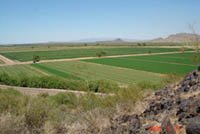
[Source: Ruben Hernandez] -- Marie Lopez was born in a migrant camp on Goodyear Farms in the West Valley in 1957. Five farm worker camps for Mexican American laborers were created in 1917 by the Goodyear Tire & Rubber Company in the area of the Valley now named Litchfield Park. Lopez's early memories were of hundreds of members of her extended family -- "Everybody took care of each other's kids." Dirt roads crisscrossed farmlands of cotton, lettuce, onions and alfalfa that stretched to the western horizon. In the evening, Mexican music drifted from the migrants' shacks, and cars and trucks unloaded hungry workers returning from laboring in the fields all day. Today, Goodyear Farms, along with the migrant way of life for many Latinos in the West Valley, have disappeared. Almost a century later, history reveals a generational exodus of the Latino harvesters into new towns and cities, and into different ways of earning a living. Urbanization has steadily nibbled away at West Valley farmland.

Today, hundreds of thousands of acres of cropland have been converted into auto and shopping malls, restaurant rows and vast swatches of family homes. This year Arizona surpassed the rest of the nation in adding new residents. And the fastest growing region of the state is the West Valley. Western Maricopa County has overtaken the East Valley as the supergrowth region, mid-decade Census figures show, with much future growth predicted. Economic forecaster Elliot Pollack, whose firm Elliot Pollack & Co. reports economic trends, predicts the West Valley's population and housing explosion will grow strong for decades. About 44 percent of the Valley's population is expected to live in the West Valley by 2020, Pollack said during a presentation to WestMarc, the region's economic development organization. About 58 percent of the Valley's housing units built in the next decade in the western Maricopa County. For Lopez - now bearing the married name of Marie Lopez Rogers and the title of mayor of Avondale - the recollections are bittersweet. "You have mixed feelings to see the past go away," she says. [Note: To read the full article, click here.]

Monday, March 05, 2007

This day in history

March 5, 1770: Civilians and soldiers clash in the Boston Massacre. On the cold, snowy night of March 5, 1770, a mob of angry colonists gathers at the Customs House in Boston and begins tossing snowballs and rocks at the lone British soldier guarding the building. The protesters opposed the occupation of their city by British troops, who were sent to Boston in 1768 to enforce unpopular taxation measures passed by a British parliament without direct American representation. The previous Friday, British soldiers looking for part-time work and local Bostonian laborers had brawled at John Hancockýs wharf. Peace settled over the city during the two-day observance of the Puritan Sabbath. However, tempers on both sides were still flaring and no one expected Monday, March 5, to pass without incident. After sunset, the brawl between Boston civilians and British soldiers began again.

When the customs-house sentinel called for assistance, a British corporal and seven soldiers came to his aid. Two of these reinforcements had been among the soldiers brawling on Hancockýs wharf the previous Friday. British Captain Thomas Preston assumed command of the riled Redcoats and ordered them to fix their bayonets. As the crowd dared the snow-pelted soldiers to fire, Private Hugh Montgomery slipped and fell, leading him to discharge his rifle into the jeering crowd. The other soldiers began firing a moment later, and when the smoke cleared, five colonists were dead or dying. Three more were injured. The deaths of the five men are sometimes regarded as the first fatalities of the American Revolution. The British soldiers were put on trial, and John Adams and Josiah Quincy Jr. agreed to defend the soldiers, in a show of support of the colonial justice system. When the trial ended in December 1770, only two of the six British soldiers were found guilty of manslaughter. They were branded on the thumb and released.

Sunday, March 04, 2007

Manross: No light rail for Scottsdale Road

[Source: Ari Cohn, Tribune] -- Scottsdale Mayor Mary Manross Thursday came out against light rail on Scottsdale Road and called for a bond issue election next year to finance tourism projects, including a Western heritage museum and a nature center in the McDowell Sonoran Preserve. However, some of the proposals, particularly the bond issue, could be a tough sell to her fellow City Council members. Councilman Jim Lane said he wouldn’t rule out an election, but said he needed more information before making a decision. “I like to focus on core municipal functions,” Lane said. “That’s my primary thing.” During her annual State of the City speech, Manross called transportation “the No. 1 issue, without question.” But a $70 million-a-mile proposal to build light-rail transit on Scottsdale Road and connect it to a 20-mile system planned in adjacent cities is not the way to go, she said.

Scottsdale has yet to see if light-rail projects in Phoenix, Tempe and Mesa will be effective, Manross said. But downtown Scottsdale and Old Town are unique and need to be protected, she said. “Let there be no question about it, that while I support improved transit opportunities on our signature road, I do not support light rail on Scottsdale Road going through the heart of our downtown,” Manross said. She said construction is set to begin this summer on a Loop 101 car pool lane between Tatum Boulevard and Princess Drive to handle a bus rapid transit system. “Coupled with park-and-ride lots and other local transit connectors, (bus rapid transit) can fill an important transportation gap for our work force commuting to and from Scottsdale and help us reduce the number of cars on our local streets,” Manross said. The city’s transportation master plan is expected to be done this fall, she said, and Scottsdale expects to expand its network of bicycle, pedestrian and equestrian paths. [Note: To read the full article, click here.]

Saturday, March 03, 2007

Developer seeks to preserve ancient ruins

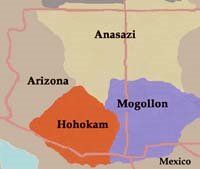
[Source: Mark Havnes, Salt Lake Tribune] -- The ancient Anasazi carved out an existence in the hills outside Kanab. They dug pits, hunted elk and grew maize. Now, St. George developer Milo McCowan wants to carve out a subdivision on those same slopes. He wants to build homes, sculpt trails and erect an amphitheater. Oh, and he wants to save - and even capitalize on - many of those American Indian ruins. "We are dedicating 20 acres in the project for long-term archaeological excavation and study, hopefully in partnership with a university," McCowan said. "Amateur archaeologists could move here and live and assist with a significant dig in their own neighborhood." At his subdivision - named Chaco Canyon after the famous Anasazi ruins in New Mexico - McCowan plans to build 700 to 800 houses and town homes on 270 acres west of Kanab Creek, which are in the process of being annexed into Kanab.

The homes will be clustered to make way for open spaces and trails. McCowan also hopes to add an amphitheater for the performing arts and a museum for showcasing the area's artifacts. The entrance road will wind between two ruin sites. Doug McFadden, former head archaeologist with the Bureau of Land Management's nearby Grand Staircase-Escalante National Monument, said the ruins - at 14 sites - offer excellent examples of how the Virgin Anasazi lived from the year 1 to the 1200s, when they abruptly vanished. McFadden, whose private consulting firm conducted an archaeological survey of the area for McCowan last spring, said the ancient dwellings - layered and built in blocks of rooms - were used for residential and storage space. They extend down about 15 feet.

Note: To read the full article, click here. Photo source: Mark Havnes.

Thursday, March 01, 2007

City Council Arts, Culture and Historic Preservation Subcommittee

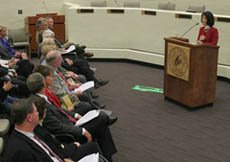
[Source: Barbara Stocklin] -- On February 22, 2007, the Arts, Culture and Historic Preservation Subcommittee met and recommended City Council approval to expend up to $40,000 in available Historic Preservation Bond Funds for four (4) Exterior Rehabilitation matching grant rehabilitation projects; to execute a contract with Heritage Architecture and Planning to update the city’s historic preservation design guidelines using up to $85,000 in available Historic Preservation Bond Funds; and to apply retroactively for a matching $10,000 Certified Local Government Pass-Through Grant to fund the production and publication of the design guidelines. The Historic Preservation Office also presented a report on its recently completed Customer Service Survey to the Subcommittee. Several members of the Historic Preservation Commission and the public were present at the meeting to speak on these items.

This day in history

March 1, 1961 : Peace Corps Established. On March 1, 1961, President John F. Kennedy issues an Order establishing the Peace Corps as a new agency within the Department of State. The agency would send trained Americans to foreign nations to assist in development efforts. The Peace Corps captured the imagination of the U.S. public, and during the week after its creation thousands of letters poured into Washington from young Americans hoping to volunteer. The Peace Corps proposal gained momentum in the final days of Kennedy's campaign, and on November 8 he was narrowly elected the 35th president of the United States.

On January 20, 1961, in his famous inaugural address, he promised aid to the poor of the world. "To those peoples in the huts and villages of half the globe struggling to break the bonds of mass misery," he said, "we pledge our best efforts to help them help themselves, for whatever period is required--not because the communists may be doing it, not because we seek their votes, but because it is right." He also appealed to Americans to "ask not what your country can do for you, ask what you can do for your country." On September 22, 1961, Kennedy signed congressional legislation creating a permanent Peace Corps that would "promote world peace and friendship" through three goals: (1) to help the peoples of interested countries in meeting their need for trained men and women; (2) to help promote a better understanding of Americans on the part of the peoples served; and (3) to help promote a better understanding of other peoples on the part of Americans. By the end of 1963, 7,000 volunteers were in the field, serving in 44 Third World countries.

Group pushes hip downtown Phoenix

[Source: Ginger D. Richardson and Erica Sagon, Arizona Republic] -- San Diego has the Gaslamp Quarter, Miami has South Beach and Denver has LoDo. Now, a group of private developers wants to create a hip hangout spot in downtown Phoenix, one that rivals or even surpasses those found in some of the nation's greatest cities. The proposed Jackson Street Entertainment District would cut a path across the southern end of downtown Phoenix, AZ, stretching from Central Avenue to Chase Field, and could be anchored by the state's first House of Blues music venue. The blockbuster proposal is significant because it addresses downtown Phoenix's lack of full-time residents and nightlife, both of which are key to turning the area into a true destination spot. The new district, when complete, could boast comedy clubs, signature restaurants, live-music spots and art galleries, as well as office space, housing units and a hotel.

Dale Jensen, part owner of the Phoenix Suns and Arizona Diamondbacks, is one of Jackson Street 's backers. He said he and his business partners decided to move forward with the idea after realizing that there was nothing to keep people downtown after a Suns or Diamondbacks game. "The thought was, we have these two big boxes in downtown, the arena and the ballpark, but we really have nothing for people to do but go to that box and go home," he said. Jackson Street marks the second time in recent months that the private sector has turned its attention to downtown Phoenix in a big way.

[Note: To read the full article, click here. Photo source: Leanne Matzenger.]