Sunday, May 07, 2006

Prescott celebrates "Dozen Distinctive Destination" with May 9 lunch and awards presentation

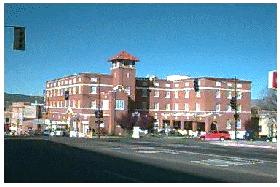
The City of Prescott will celebrate being named one of America's "Dozen Distinctive Destinations," an honor bestowed on a select few by the National Trust for Historic Preservation, with a luncheon and award presentation at the May 9 City Council meeting. Anthony A. Veerkamp, Senior Program Officer, Western Office of the National Trust, visits Prescott that day to present the award to city officials at the 3 p.m. meeting in City Council Chambers. Refreshments will be served for all attending following the meeting. Veerkamp will also address attendees at the invitation-only luncheon at the Hassayampa Inn (pictured above), which is a Historic Hotel of America and was featured in the nomination for the award. City officials, local business owners and citizens who have been key in historic preservation in Prescott will be attending the luncheon.

The National Trust, the largest private, non-profit preservation organization in the U.S., selected Prescott from 93 destinations in 39 states. Only 12 communities across the country are chosen as Distinctive Destinations each year. "Prescott offers visitors an opportunity to experience a vibrant and exciting city that blends the best of small-town hospitality with authentic western feel," said Richard Moe, president of the National Trust. "When you combine the spectacular natural beauty of the region with Prescott's architectural and cultural heritage, it's easy to see why this is such an ideal destination."

The city's frontier past, its dedication to preservation of historic places and buildings, museums, vibrant downtown area, and many options for outdoor enthusiasts are all distinguishing characteristics of Prescott that won the designation. Prescott's historical prominence as the two-time territorial capital, as well as its more than 700 buildings listed in the National Register of Historic Places, contributed to its success in the nomination, which was prepared by the city's Historic Preservation Specialist Nancy Burgess, Economic Development Director Jane Bristol, and Economic Development Secretary Donna Orman. The Prescott Chamber of Commerce and Prescott Downtown Partnership supported the city's application. "We are thrilled to accept this honor on behalf of the people of Prescott, the business community, and city employees who work tirelessly to maintain the charm and historic integrity of Prescott," said Mayor Rowle Simmons.

The city was previously named a Preserve America Community by First Lady Laura Bush for its commitment to historic preservation. It is also designated an Arizona Main Street Community by the Arizona Department of Commerce.

Saturday, May 06, 2006

Mesa's financial woes plague cultural, education, and heritage programs

[Source: Greg Marek, Marek Consulting Resources] -- The City of Mesa is facing a severe financial crisis, and if Mesa voters do not approve a sales tax increase and a property tax at the May 16 election, many City services will be cut, including funding for museums, libraries, and the Mesa Grande archaeological site. Unfortunately, even if both the sales tax and property tax issues are approved on May 16, Mesa’s museums and preservation programs still face cutbacks. Consider:
  • If both tax measures fail, the Mesa Southwest Museum and the Arizona Museum for Youth will close on July 1. If that happens, Mesa will be the first city in the U.S. to close a municipally operated museum. If only the sales tax measure passes, then funding will be cut by 50%, which basically starts the process of closing the museums. Even with reduced funding, research and public outreach activities at Mesa Southwest will be curtailed.
  • Once funded with $150,000 by the City of Mesa, the Mesa Historical Museum will lose its remaining $75,000 in City funding starting July 1 and that will not be restored. History and preservation advocates are struggling to raise replacement funding, but the Mesa Historical Museum is also in jeopardy.
  • If both tax measures fail, the two branch libraries will probably close. The libraries are already on reduced hours and the Mesa Room is open by appointment only and has only one staff person assigned to it. Questions remain on how historic documents will be added to the Mesa Room’s collection for research purposes.
  • Already dramatically curtailed, funding for the City of Mesa’s Historic Preservation Program could be jeopardized.
  • As to Mesa Grande Ruin, no one really knows what will happen. There has never been much support from city officials for Mesa Grande, and this has not changed. Its future is in doubt even though studies have demonstrated that if operated as an interpretive site, Mesa Grande would attract more than 150,000 annual visitors. If the Mesa Southwest Museum has to close, they will try to find some organization to take over Mesa Grande.
What most people do not understand is that if both tax measures pass, the City is not out of the financial woods. The City will have a stable long-term revenue source, but funding for the museums, libraries, arts, and other related programs will be reduced from previous levels. This is very serious. Mesa’s museums are more than local institutions. They are regional attractions.

City leaders need to hear from visitors and those that use the resources from these institutions from wherever they come. Interested individuals are encouraged to send e-mails and letters to City Council members and City Management supporting the museums, Mesa Grande, libraries, and the Mesa Room before the City Council adopts the final budget on June 5.

For more information, click here for the Yes for Mesa Campaign.

Glendale's Marty Robbins museum closes

[Source: Maura J. Halpern, Arizona Republic] -- Almost three years after Juanita Buckley opened the Marty Robbins Glendale Exhibit in downtown's Catlin Court district, she had to shut it down due to a lack of money. Buckley, a longtime admirer of the late country-music star, has her 40-year-plus collection of Marty Robbins memorabilia in storage as she searches for a new space to house the exhibit. While traffic was always high, the funds flowing in to maintain the building and help pay the mortgage were minimal, Buckley said. The museum's last day was March 21. "When I had to close, I felt like Marty died all over again," said Buckley, 65. "When you put your heart and soul into something and it happens and then you realize you can't do it, it's heartbreaking..."

Ron Short, Glendale's deputy director for long-range planning, also serves as staff liaison to the city's historic preservation committee. He said Wednesday that he was saddened to hear of the exhibit's closure. "It was an important tourist activity for the downtown area," he said. "...We're sorry to see it go because her (Buckley's) heart and money were all in it." [Note: To read the full article, click here.]

Friday, May 05, 2006

Tucson working to save its "recent past"

[Source: Brooks Jeffery and Marty McCune] -- With many baby boomers well into their 50s, post-World War II architecture is also getting up there in age. In Tucson, historic preservation advocates are working to save and preserve the latter.

The Modern Architecture Preservation Project (Tucson) was created in 2003 to raise awareness of the value of modern architecture as a significant chapter of Tucson's architectural heritage. This volunteer group has conducted tours in collaboration with the local chapter of the AIA, initiated a survey of modern resources, and has acted as an advocate to preserve buildings and environments of the modern movement in Tucson.

The context study, "Architecture of the Modern Movement in Tucson, 1945-1975" by Chris Evans and R. Brooks Jeffery, defines the various themes of significance that apply to Tucson's modern architectural heritage and forms the foundation for the nomination of individual buildings of Tucson's modern movement to the National Register of Historic Places.

In conjunction with the context study, students from the Preservation Studies program at the University of Arizona have drafted nominations for ten buildings to the National Register of Historic Places, based on their significance and potential threat. These buildings include:
  • 1st National Bank (now Chicanos Por La Causa), 200 N. Stone Avenue, 1966 by Cain Nelson Wares
  • 1st Christian Church, 740 E. Speedway, 1948 by Arthur Brown
  • Wilmot Public Library, 530 Wilmot Road, 1964 by Nicholas Sakellar
  • Tucson Clinic, 116 N. Tucson Blvd, 1954 by Scholer, Sakellar & Fuller
  • Catalina Baptist Church, 1900 N. Country Club, 1960 by Charles Cox
  • Mettler Dance Studio, 3131 N. Cherry, 1963 by John Howe (pictured above)
  • Ball-Paylore House, Catalina Vista neighborhood, 1952 by Arthur Brown
  • Ramada House, Catalina Foothills, 1975 by Judith Chafee
The City of Tucson has contracted with Akros, Inc. to identify significant post-war neighborhoods and housing types, develop methods of analysis and interpretation for future planning purposes, and to identify potential National Register historic districts. This work is being done with the Preservation Studies class at the University of Arizona.

Thursday, May 04, 2006

Phoenix City Council approves A.E. England Building zoning request

On May 3, 2006, the Phoenix City Council approved historic preservation zoning for the A.E. England Motor Company, 424 N. Central Ave. (top photo of current condition; bottom rendering of possible adaptive reuse).

City of Phoenix Parks & Recreation Department, Arizona State University, and other interested parties have begun the process of planning for a "civic space" between the historic U.S. Post Office on the north and bus station on the south. Funding for both the "civic space" and renovation of the A.E. England Building were approved by Phoenix voters on March 14 as part of the City's 2006 Bond Program. For more information, contact Barbara Stocklin at 602-261-8699.

Wednesday, May 03, 2006

Moving backwards: A step in the right direction for Willcox Historic District

[Source: Ainslee S. Wittig, Arizona Range News] -- Louise Henderson doesn't do things halfway. When she decided to move to the area, she did what she's always done. She got involved in the community. Since her arrival in town several years ago, she has purchased 113 lots on the east side of the city of Willcox and she hopes to help bring Willcox to a more prosperous state. Possessed by a love of preserving history and beauty, she is now in the process of developing a five-bungalow neighborhood on Rail View Avenue in the Willcox Historic District. "The Historic District of Willcox is the most unique area of town with so much potential for re-emergence and growth," Henderson said.

The bungalow style she chose "has appealed to people here from the late 1890s to the early 1940s - and people all across America are still drawn to this style of home," she said. Henderson said the historic district is "easy to develop in a complimentary style, because there has been so little activity over the past 50 years. The early 1900s architectural designs are timeless and age well," Henderson said. "I believe these homes (the bungalows) will outlive us."

Henderson is working with Mascot Home Construction, owned by Stephen Klump of Willcox, as the contractor. The floor plans include both two and three bedrooms, two baths in each, with prices starting at $159,000. The first home on Rail View Avenue is a two-story priced at $179,000 and will soon be completed, she said. These bungalows are located in the Historic Preservation zoning classification, which includes residential and commercial uses, she added. [Note: To read the full article, click here.]

Historic district designation unveiled at Phoenix's Pierson Place

The City of Phoenix has designated Pierson Place Neighborhood as historic and unveiled the historic district sign at a special ceremony on May 3 as part of National Historic Preservation Month. Councilman Tom Simplot and Mayor Phil Gordon (pictured at left with neighborhood leaders at the sign unveiling) spoke movingly about the importance of neighbors working together, often overcoming obstacles, to preserve their homes and streetscapes.

Pierson Place, an early residential suburb built largely by individual property owners and mom and pop builders, is located generally between Camelback Road, Central Avenue, the Grand Canal, and Seventh Avenue. Originally outside Phoenix city limits but within a 10-minute drive to downtown, the neighborhood's first subdivision dates to 1924. In 1926, the Arizona Republican advertised half-acre lots in Pierson Place for "$400 and up," with the added convenience of "city conveniences" with "no city taxes." [Note: For more information about Pierson Place, click here.]

Tuesday, May 02, 2006

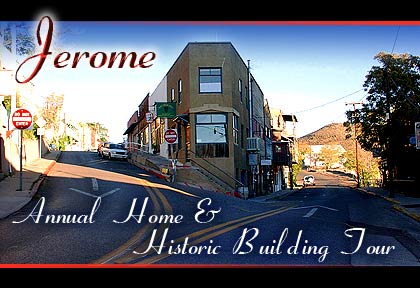
Jerome's 41st Annual Home and Historic Building Tour set for May 20-21

The big bonanza in this year’s tour may come as a pleasant surprise to many. For the first time in over 30 years the Open Pit Mine in Jerome will be included in the Home and Historic Building Tour, being held Saturday, May 20 and Sunday, May 21. According to Christine Barag, Home Tour Director, the Open Pit Mine, located on private property owned by Phelps Dodge and closed to the public, was last included on the Tour in 1972. “People will be able to walk up to and look over the edge of the pit.” Barag explained, adding that Phelps Dodge has been extremely helpful in insuring an informative and interesting experience. An overlook has been prepared, accommodations have been made to facilitate photographs, and mining personnel will be on hand to answer questions.

This year’s tour will also include a stop at the Kingdon House, once the lavish home of George Kingdon, superintendent of the Little Daisy Mine. Extensive renovations have been made by the owner, local artist, Diane Geoghan, including restoration of the ballroom. The ballroom was one of several additions to the home supervised by Mrs. Kingdon, who “liked to entertain.” Other homes included on the tour are the Pecharich House, currently the Cottage Inn, a quaint bed and breakfast, and the Kelly House known now as Gallery 527. The tour will conclude at the Lawrence Memorial Hall -- owned and operated by the Jerome Historical Society as “Spook Hall” -- where refreshments will be served.

The self-paced tour begins on Main Street; shuttles will run continuously from 9 AM to 4 PM. The last tour daily will be at 3 PM. Cost of admission is $12 for adults; $6 for children 12 years and under. Because of uneven surfaces and stairs, the tour is not wheelchair accessible and strollers cannot be accommodated. Comfortable shoes are strongly recommended. Admission to the Jerome State Historic Park will be waived with a Home Tour Ticket. For more information, contact Christine Barag at 928-634-5477.

Monday, May 01, 2006

It's National Historic Preservation Month 2006

"Sustain America: Vision, Economics, and Preservation" is the theme of National Preservation Month 2006. The National Trust for Historic Preservation is highlighting different areas of preservation related to this theme throughout the month of May with various activities and events including educational activities at National Trust Historic Sites, special events, and select vacation packages offered through the National Trust’s Historic Hotels of America, to name a few.

Preservation Month serves as a showcase for our country’s diverse and unique heritage. Thousands of state and local community groups will honor their distinct histories through various activities and bring historic preservation to the forefront of Americans’ daily lives by emphasizing the vital importance of protecting our nation’s past. There are many ways to get involved in Preservation Month, and the materials on this webpage can help.

For tips and resources on organizing Preservation Month activities in your community, click here. See how the National Trust and thousands of Americans celebrated Preservation Month 2005.
# May 1 - 7: Preservation at Home
# May 8 - 14: Historic Travel
# May 15 - 21: Heritage Education
# May 22 - 31: The Diversity of Preservation

Saturday, April 29, 2006

Scottsdale homes not old, just historic

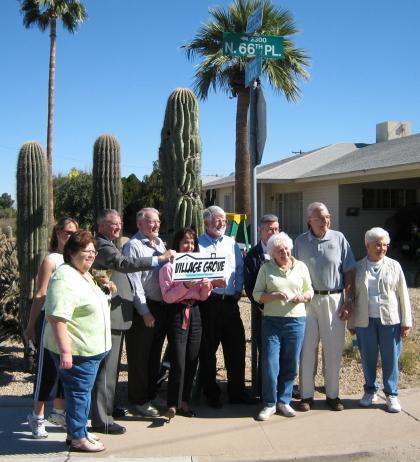
[Source: Shanna Hogan, East Valley Tribune] -- Some may describe Scottsdale’s 1950s neighborhoods as old, worn or weathered. The city’s Historic Preservation Commission views them as windows to the past. Last year, the commission designated its first two historic neighborhoods, Village Grove (pictured at left) and Town and Country Scottsdale. This year the commission hopes to do the same for at least two more. “We’re looking at neighborhoods built in the 50s,” said Don Meserve, Scottsdale’s preservation planner. “Production homebuilders were just learning their trade after World War II -- some of these 1950s neighborhoods really represent that.”

Scottsdale Estates 4, from Virginia Avenue to Oak Street west of 74th Street, and Sherwood Heights, between 56th and 60th streets north of Oak, are among the neighborhoods under consideration. The ones chosen could receive their designation by the end of the year. Using historic designation, the city is able to protect and preserve the area’s character. “It’s really considered a partnership between the city and the residents in these neighborhoods,” Meserve said.

Jesse and Cecile Rosalez are 15-year residents of Village Grove, a 255-house subdivision at the southwest corner of 68th and Oak streets. They said they sought out the neighborhood because of its classic character. “All the houses are different here,” Cecile Rosalez said. “These are solid, sturdy homes. You feel like they’ll last longer.”

[Note: To read the full article, click here. Photo source: Jennifer Hibbard, The Real Estate Twins.]

Friday, April 28, 2006

UA's Rainbow Bridge to be completed by 2010

[Source: Teya Vitu, Tucson Citizen] -- The vote for color choice was too close to call last night for the $350 million Rainbow Bridge. Town hall participants split between light orange and dark copper for the proposed arch that would suspend the Arizona Science Center over Interstate 10 and the Santa Cruz River. The polling will continue on the Internet. The public more closely embraced the 50-foot-wide walkway on the roof of the center that replaced a much narrower previous design that renowned architect Rafael Viñoly described as a "catwalk." Viñoly described the fabric covered walkway as a park setting that could have "kiosks of food, places to sit, and shading."

People also liked Viñoly's ideas to illuminate the 370-foot-tall arch with colored lights at night. "To me, to be able to see a rainbow every evening would be wonderful," said Teresa Toro, a Tucson native who is a counselor at the downtown Davis Bilingual Learning Center. The town hall at the Berger Performing Arts Center unveiled design modifications Viñoly made in response to public reaction to his earlier design, where people complained about the stark white color, ungainly buildings at both ends, and unsightly views of the freeway. Viñoly's new design builds spiral pedestrian approach ramps into berms that blocks out the freeway. The landscape also partially shelters the IMAX theater, planetarium and observatory that have been moved off the bridge and onto land at both ends.

The audience largely welcomed the Rainbow Bridge. However, a large number also leaned more toward history than futuristic design. "To me this just overwhelms anything we want to see," said Gayle Hartmann, president of the Tucson Presidio Trust for Historic Preservation. "I would like to see something more European, something low, with tiles." [Note: To read the full article, click here.]

Regents approve downtown Phoenix Ramada Inn for student housing

[Source: James Kindle, ASU State Press] -- The Arizona Board of Regents unanimously authorized ASU to lease the Phoenix Ramada Inn for the Downtown Phoenix Campus at their April 27 meeting. The Ramada will serve as housing for up to 267 students for two years starting this fall until permanent housing is built, said Richard Stanley, ASU senior vice president and university planner. "The nature of the rooms convert very nicely to student rooms without renovation," he said.

Mernoy Harrison, a vice provost for the Downtown campus, said the hotel was historic. "It is one of the oldest Ramadas in the world," he said. [Note: For more information about ASU's downtown campus, click here. For more information about the Ramada Inn, click here.]

Monday, April 24, 2006

Flagstaff cultural resources topic of April 24, 2006 City Council meeting

[Source: Marshall Whitmire and Nicole A. Woodman, Department of Geography, Planning & Recreation, Northern Arizona University] -- Monday, April 24, 2006 will be a critical day for continuing efforts to preserve and enhance Flagstaff's cultural resources, including historic districts, sites (esp. archaeological), buildings, other structures, and objects. After many months of careful development work, an extensive proposal for Heritage Resource Preservation will be made to the Flagstaff City Council at its 4 p.m. meeting at City Hall. The public is invited to attend.

Scheduled to be the first agenda item, the concept proposal will be presented by Karl Eberhard, Flagstaff's Urban Designer, using a creative and extensive PowerPoint presentation. A major emphasis of the proposed new program are the very significant sustainable economic benefits to Flagstaff and its local businesses that can result if our cultural heritage is preserved and becomes an even more central part of the city's tourism industry.

Currently, there is very little, if any, protection for even the most noteworthy of our cultural resources. In fact, under current regulations, the city would immediately have to issue a demolition permit for a building on the National Register of Historic Places if it were requested by the property owner. Without the development and implementation of the provisions of the proposal, Flagstaff's substantial cultural resources will continue to be extremely vulnerable to compromise and loss. With it, Flagstaff will be positioned to be a leader in heritage preservation in the state. For a copy of the proposal document and/or PowerPoint presentation, contact Karl Eberhard at 928-779-7632, ext. 7268.

Last call for Historic Preservation 101 workshop, Thursday, April 27, 2006 in Tucson

As part of the 2006 Arizona History Conference, a special pre-conference workshop, "Historic Preservation 101," will be held on Thursday, April 27, 2006, 9 a.m. to 4 p.m., at the Radisson City Center Hotel in Tucson. Sponsored by the Arizona Preservation Foundation, this workshop is designed for professionals and non-professionals who have little or no experience in historic preservation or who want to begin a historic preservation project. Professionals from the private and public sector will disseminate information on National Register of Historic Places, U.S. Secretary of Interior Standards for Rehabilitation, State Historic Preservation Office programs and policies, and local topics (researching a historic property, preservation and designation process, and preservation techniques and resources). Workshop leaders:
  • William Collins, State Historic Preservation Office, “The State Historic Preservation Office and You”
  • Ralph Comey, Ralph Comey Architects, “Working with Consultants”
  • Janet Parkhurst, Janet H. Strittmatter, Inc., “Researching a Historic Property”
  • Eric Vondy, State Historic Preservation Office, “Benefits and Tax Incentives for Historic Properties”
Registration fee: $25 (lunch not included). Send an e-mail to Vince Murray and include your name, organization, street address, city, state, zip, day phone, and e-mail address. Bring your check (made out to Arizona Preservation Foundation) to the workshop.

Saturday, April 22, 2006

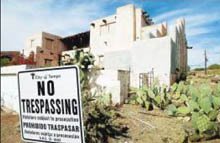
Tempe's Eisendrath House in need of help

[Source: Garin Groff, East Valley Tribune] -- Tempe’s historic Eisendrath House is celebrated for its adobe construction. But that treasured feature also threatens the home’s existence unless volunteers can raise some quick cash and reverse the aging process. The city-owned structure is essentially melting -- deteriorating in a process called adobe melt. The origin of the term is obvious to anybody who has seen walls that resemble a snow fort melting in the spring. Unless workers stop the melt soon, the house will crumble beyond repair. “It’s really deteriorated dramatically,” said Vic Linoff, a member of the Tempe Historic Preservation Foundation.

The work could cost $2 million. The city and community organizations expect to make their first significant financial progress this year during various events, including a May 6 fundraiser. Organizers hope to raise $20,000, but Mayor Hugh Hallman said he’ll announce a more substantial funding source at that event.

The home’s melting is obvious from the outside. Deep cracks in the stucco expose areas where walls that were once a foot thick are nearly gone. Some of the rose-tinted stucco is covered with modern, gray patches. The patches were done with the best of intentions, likely by an artist who rented the house in the 1980s and 1990s. But the patches have done more harm than good, said Darlene Justus, president of the foundation. The original stucco breathed and kept walls from getting too moist, but the modern stucco mix trapped moisture.

The city’s first priority is to fix the cracks and redo the roof to ensure rain doesn’t get inside. Also, the city needs to shore up the second floor because the adobe construction doesn’t tie it to the walls securely enough, said Joe Nucci, Tempe’s historic preservation officer. That will cost about $600,000. After that, the city would make nonstructural repairs and prepare the house for some other use. Officials have mentioned a museum, community meeting place or city offices, but no decision has been made.

[Note: To read the full article, click here. Photo source: Toru Kawana, East Valley Tribune. The fundraiser is 6 p.m. May 6, Tempe Historical Museum, 809 E. Southern Ave. $75 per person. R.S.V.P. by Friday. For more information, call 480-946-2168.]